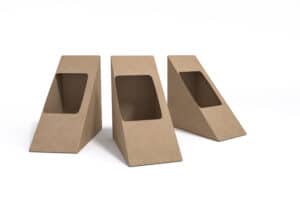
What does ‘widely recycled’ mean and how is it affecting sandwich packaging in the UK? The problem is the term does not mean that much and for an industry worth £8bn a year in the UK this is having an impact on our environment.
Much like a window on an envelope the presence of plastic makes it hard to know if a sandwich box goes in the recycling bin or the normal bin.
We in the industry know it can only be recycled if the various elements of the packaging are separated. But consumers commonly do not and the term ‘Widely Recycled’ on packaging does little to help this. Whilst sandwich packaging has obviously evolved since 1980 when Marks & Spencer launched its pre-made sandwiches, it still has some way to go to meet the demands of 2020 and beyond.
Chapelton advise clients who are searching for the right packaging materials. We can help you address the ‘widely recycled’ challenges that food manufacturers are facing. Call us on 01622 882280 or request a call back and we will contact you.
Widely Recycled and the War On Plastics
As consumer attitudes increasingly impact buying habits it was no surprise to see the subject posed by the BBC in their recent War On Plastic series. As a food packaging advisor and buyer of food packaging materials Chapelton are always looking at ways these issues can be tackled.
As we’ve said before on this blog it is a case of:
- Consumer knowledge and choice
- Industry innovation and responsibility
- Infrastructure to manage waste and recycling
Trewin Restorick, chief executive of environmental charity Hubbub pointed out on their blog, the programme did not exactly focus on all of these points. It is ok for consumers to be ‘horrified’ but quite likely if the choice was stay the same, no sandwiches in the supermarket or go to your local sandwich shop, then the desire for convenience and freshness would see ‘stay the same’ choice win out against environmental concern.
That is not to say that is right but without appropriate education how can we expect consumers to exert the right kind of pressure on the retail industry? They wont and then the wrong decisions will be made to appease the issue.
Food To Go packaging innovation
Of course Chapelton champions innovation in cartonboard, cardboard and paper packing. New innovations in materials and applications are constant as was illustrated by Sirane’s Earth Packaging range which was featured in the programme. We expect to see many more packaging solutions in the food to go and retail arena which will seek to remove plastics completely.
We do also recognise though, that when it makes sense for a product to use plastic along with cartonboard and other materials in its packaging, then manufacturers should elect to do so. When it costs less to produce and transport. If it keeps it fresher for longer. And if it makes it more desirable for the consumer to purchase, then these could all be cases for the use of some plastic.
The caveat for that though is when consumers are educated properly and the infrastructure is in place to reuse it or to recover the energy in an Energy from Waste (efW) plant.
Evolving the way we recycle plastic
The UK can and should recycle more of its plastic. Encouraging a more circular economy and creating the infrastructure to support it could steer a more sensible use of plastic.
This positive scenario can then be presented to consumers as a way to ensure they make informed choices and also recycle more effectively.
As a second option for plastic waste there are increasingly positive levels of support for plastics to go to Energy for Waste (EfW) plants rather than being sent halfway around the world for processing by countries where no controls are in place.
Turning it into energy for UK households rather than polluting the sea and air elsewhere is arguably a much better option for the environment.
As the British Plastics Federation succinctly put it in their response to the programme:
“Plastic needs to be used responsibly and where it provides value, and then ultimately recycled in all cases where possible. When it is not possible, in most cases, recovering the energy at an Energy from Waste (EfW) facility is the next best option.”
How to evolve your food to go packaging
Programmes like the BBC’s War On Plastics do a great job in nudging consumer and media attitudes. The hard work comes in responding to them and making changes.
Clients of Chapelton are always asking what other companies are doing in the industry or parallel industries. It is our experience across these industries that leaves us in a unique position to advice and source the best materials for your product and sector.
Complete the request a call back form on our Food Packaging page or simply call us now on 01622 882280.
catch up on other packaging news...

Vegan & Vegetarian Packaging Material
Vegan & Vegetarian Packaging Materials
With veganism and vegetarianism becoming ever more popular companies are looking for ways …
The Widely Recycled Challenges For Sandwich Packaging
Creating food to packaging solutions that meet product needs and recycling goals is not always easy.
Photo by tanvi sharma on Unsplash